

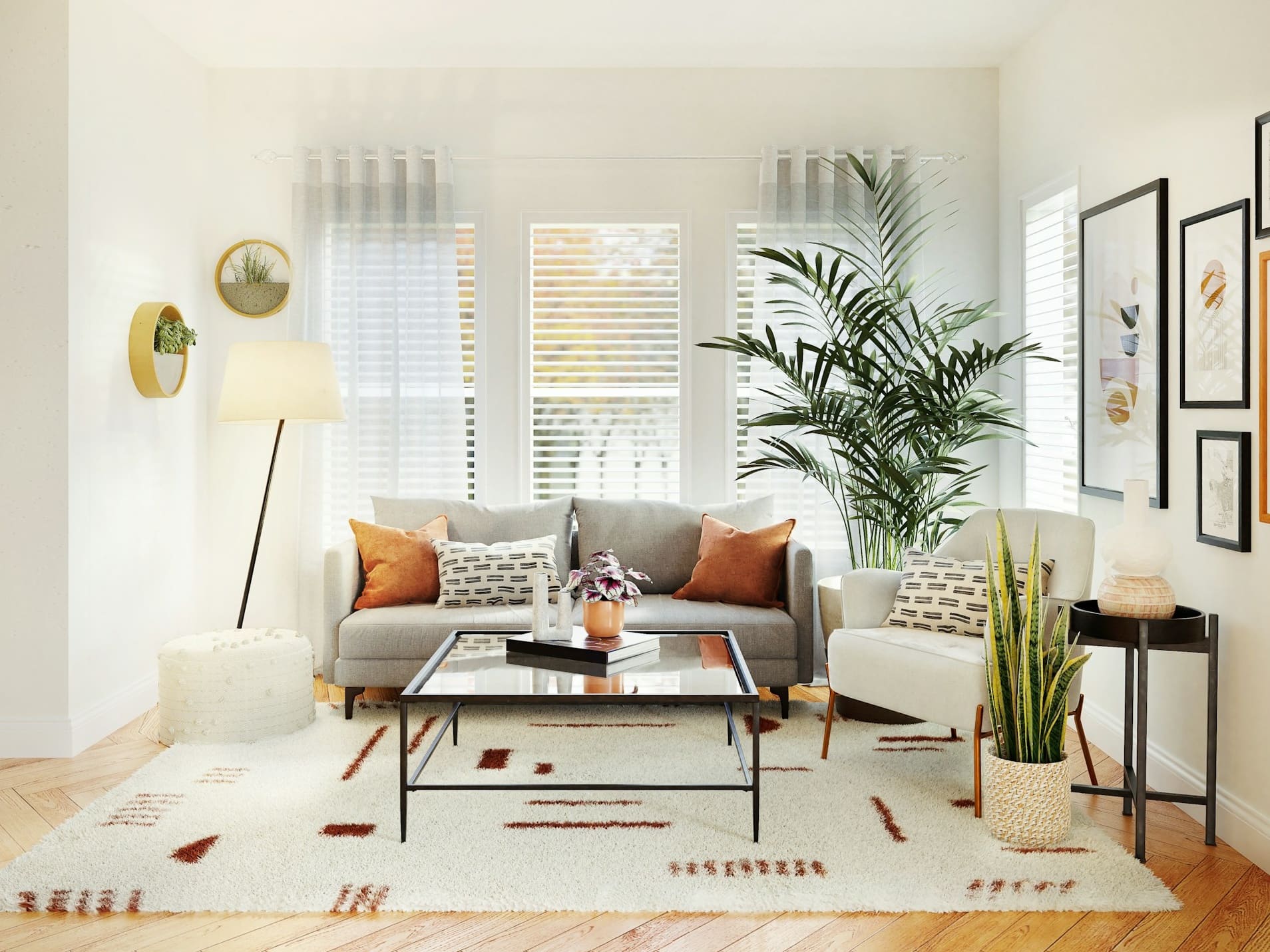
A small living room can fit all the things you technically need—a sofa, coffee table, TV, storage, lamps, and décor—and still feel crowded.
The problem is not always the room’s actual size. Sometimes the layout blocks natural movement. Sometimes there are too many small pieces competing for attention. In other rooms, bulky furniture hides most of the floor, dark corners make the edges harder to read, or open shelving adds more visual noise than useful storage.
The most effective small living room ideas focus on how the room functions and how your eye moves through it. You do not need to remove everything or paint every surface white. A better approach is to improve the layout, choose furniture at the right scale, protect light, control visual clutter, use walls more effectively, and create a more continuous overall look.
Start With the Layout Before Buying Anything
Before changing paint colors, ordering a new rug, or adding mirrors, look at the floor plan.
A difficult layout can make even good furniture feel oversized. A clearer arrangement can make the same room easier to move through and visually calmer.
Decide What the Living Room Actually Needs to Do
Start by identifying how you really use the room.
Your living room may need to support:
- Watching TV
- Conversation
- Reading
- Working from home
- Children’s play
- Occasional dining
- Entertaining
- Overnight guests
The challenge is that a small room cannot always give every activity equal space.
Ask yourself:
- What happens here every day?
- What happens only occasionally?
- Which furniture pieces exist for rare situations?
- Which functions could share the same furniture?
If you use the room mainly for relaxing and watching TV, for example, you may not need permanent seating for eight people. Extra seating can come from lightweight chairs or a pouf that moves when needed.
Protect Clear Walking Paths
A room feels more comfortable when you can enter, sit down, and move through it without weaving around furniture.
Look for obvious obstacles:
- A coffee table directly in the path from the doorway
- A side chair blocking access to another room
- A large ottoman that leaves no easy route to the sofa
- Storage furniture squeezed into an important walkway
Move through the room as you normally would and notice where you naturally turn, pause, or walk.
Design around those paths instead of forcing people to move around the furniture.
Don’t Automatically Push Everything Against the Walls
Putting furniture against the walls can be useful in some narrow rooms, but it should not be the automatic answer.
If the room allows it, pulling a sofa slightly forward can sometimes create:
- A clearer seating zone
- Space for a slim console behind it
- Room for lighting
- Hidden storage
- Better visual separation between functions
The right choice depends on the actual shape of the room.
If moving the sofa forward creates an awkward gap or blocks circulation, keep it closer to the wall. The goal is a better layout, not following a decorating rule.
Choose Fewer Furniture Pieces at the Right Scale
One of the most common misconceptions about small rooms is that every piece of furniture should be tiny.
That approach can backfire.
A room filled with several small chairs, narrow tables, stools, cabinets, and side pieces can look more fragmented than a room containing fewer, appropriately scaled furnishings.
Start With the Largest Necessary Piece
In most living rooms, the main piece will be:
- Sofa
- Loveseat
- Sectional
- Media unit
Choose that piece first.
Consider:
- How many people use it regularly
- The room’s shape
- Door positions
- Available floor space
- Other functions the room needs to support
Then add secondary furniture only when it serves a real purpose.
Avoid Both Oversized and Undersized Furniture
Furniture that is too large may:
- Block walking paths
- Hide too much visible floor
- Overpower nearby pieces
- Make doors or storage difficult to access
But too many undersized pieces create their own problems.
Every extra table, chair, cabinet, and stool adds:
- More legs
- More edges
- More gaps
- More visual interruptions
The goal is not miniature furniture. It is proportional furniture.
Look for Slimmer Profiles
When comparing two pieces that offer similar function, the visually lighter option may work better.
Look for features such as:
- Narrow sofa arms
- Tight-back seating
- Shallow side tables
- Slim consoles
- Compact armchairs
- Wall lights where appropriate instead of another bulky lamp table
A sofa with very thick arms, for example, may consume noticeably more floor area without providing additional seating.
Consider Furniture With Visible Legs
Raised furniture can reveal more of the floor underneath.
This works particularly well with:
- Sofas
- Armchairs
- TV units
- Side tables
- Coffee tables
Seeing continuous flooring beneath several pieces can make the room feel less visually blocked.
You do not need every item to have tall legs. A balance of grounded and raised furniture can work well.
Use Multifunctional Furniture Without Overloading the Room
Multifunctional furniture can be genuinely useful in a small living room—but only if both functions solve real problems.
Useful examples include:
- Storage ottoman
- Sofa bed
- Nesting tables
- Storage bench
- Console with drawers
- Pouf that doubles as extra seating
Choose Pieces That Replace Something Else
A storage ottoman is useful if it replaces both a footrest and a separate storage basket.
A sofa bed makes sense if you actually need occasional sleeping space.
Nesting tables are helpful when you want extra surfaces only when guests visit.
The important question is:
What does this piece allow me not to buy?
If the answer is nothing, it may simply be another piece occupying floor space.
Use Movable Furniture for Occasional Needs
Consider flexible items such as:
- Lightweight side tables
- Poufs
- Nesting tables
- Small trolleys
- Foldable extra seating
These pieces can move when your needs change instead of permanently occupying valuable floor area.
Reduce Visual Clutter Before Adding Décor Tricks
Before buying a mirror to “make the room bigger,” reduce the amount of visual competition already in the space.
A room can feel crowded even when there is technically enough walking space.
Clear the Main Visual Surfaces
Start with the places your eye notices first:
- Coffee table
- TV unit
- Side tables
- Window sills
- Open shelves
You do not need to remove all personality.
Instead of six candles, several trays, piles of magazines, remotes, and multiple decorative objects on one table, you might keep:
- One tray
- One decorative object or plant
- Current reading material
Editing gives the things you keep more impact.
Mix Open and Closed Storage
Open shelving works well for items you actually want to see.
Closed storage is often better for visually busy categories such as:
- Cables
- Toys
- Games
- Electronics accessories
- Paperwork
- Remote controls
- Miscellaneous household items
A room filled entirely with open shelving can quickly become visually dense.
Combining display storage with concealed storage gives you a place for attractive objects without putting every practical item on show.
Control Cable Clutter
TV and charging areas can become visually messy surprisingly quickly.
Try to:
- Remove unused cables
- Keep chargers in one defined location
- Route visible cables neatly
- Avoid spreading extension cords across open floor areas
Any electrical products should still be used according to manufacturer instructions.
Leave Some Empty Space
Not every surface needs décor.
Not every corner needs a plant.
Not every wall needs artwork.
Empty areas give your eye somewhere to rest and make individual pieces easier to notice.
This is especially useful in a small room, where adding one more decorative object can sometimes create more visual noise than value.
Use Vertical Space Instead of Filling More Floor Space
If the floor is crowded, look upward.
Walls provide opportunities for storage and visual interest without requiring another cabinet on the floor.
Take Storage Upward
Options may include:
- Tall bookcases
- Wall-mounted cabinets
- Floating shelves
- Vertical modular storage
- Pegboards where appropriate
- Higher shelves for items used less frequently
Tall storage can be particularly effective when it replaces several low units scattered around the room.
Use Tall Elements to Draw Attention Upward
Vertical elements can help guide the eye higher in the room.
Examples include:
- Tall bookcase
- Vertical artwork
- Full-height curtains
- Tall plant
- Slim floor lamp
- Vertical gallery arrangement
These elements do not physically change the ceiling height, but they can create a stronger vertical emphasis.
Don’t Turn Vertical Storage Into Vertical Clutter
A wall full of shelves can feel busier than a low cabinet if every inch is packed.
Mix:
- Books
- Closed boxes
- A few decorative pieces
- Empty shelf space
If possible, use some storage with doors to hide visually noisy categories.
Mount Wall Storage Correctly
Wall-mounted shelves and cabinets depend on:
- Wall construction
- Correct fastener selection
- Product design
- Intended load
- Manufacturer instructions
Do not guess about load capacity or mounting hardware.
If you are unsure about the wall or fixing method, verify the requirements before mounting anything heavy.
Improve the Lighting Instead of Relying on One Ceiling Fixture
A single ceiling fixture may technically illuminate a room while still leaving corners dark and the overall space flat.
Layering different light sources can make the room feel more balanced and comfortable.
Protect Natural Light
Avoid unnecessarily blocking important windows with:
- Tall cabinets
- Bulky shelving
- Large furniture
- Heavy objects sitting directly in front of the glazing
Choose window treatments based on the privacy and light control you actually need.
Keeping the window area visually open allows daylight to reach farther into the room.
Layer Artificial Lighting
Think of lighting in three basic layers.
General Lighting
This provides broad illumination.
Examples:
- Ceiling fixture
- Pendant
- Flush or semi-flush fixture
Task Lighting
This supports specific activities.
Examples:
- Reading lamp
- Adjustable wall light
- Desk lamp if the room doubles as a workspace
Accent or Ambient Lighting
This adds softer light and highlights particular areas.
Examples:
- Small table lamp
- Shelf lighting
- Wall lighting
You do not necessarily need all three in large quantities. Even adding one well-placed reading light to a room that relies entirely on overhead lighting can create more visual depth.
Use Wall or Clamp Lighting When Floor Space Is Tight
If you lack room for another side table or large floor-lamp base, consider lighting that attaches to the wall or suitable furniture.
Always follow product and electrical installation instructions, especially for hardwired fixtures.
Use Mirrors Strategically, Not Automatically
Mirrors can reflect light and create an impression of additional depth, but placement matters.
Reflect Something Worth Seeing
A mirror can work well when it reflects:
- A window
- A bright area
- Artwork
- An open doorway
- A visually calm section of the room
It is less helpful if the main reflection is:
- Cable clutter
- Crowded shelving
- A messy desk
- An especially dark corner
Before mounting a mirror, hold it temporarily in the proposed position and check the actual reflection.
Consider One Larger Mirror
A group of small mirrors can work decoratively, but every frame creates another visual edge.
In some rooms, one larger mirror produces a cleaner composition.
Treat this as an aesthetic option rather than a universal rule.
For large or heavy mirrors, use mounting hardware suitable for the wall type and actual weight.
Choose Color for Continuity, Light, and Mood
You will often hear that every small room must be painted white.
That advice is too simplistic.
Light colors are frequently used when the goal is a bright, open appearance because they generally reflect more available light, but color perception also depends on:
- Natural light
- Room orientation
- Artificial lighting
- Surrounding colors
- Contrast
- Finish
- Desired mood
Light Colors Are an Option, Not a Requirement
A pale neutral may be a good fit for a small living room that receives limited daylight and where you want a light, airy atmosphere.
But a darker color can also work if you prefer a more cocooning or dramatic room.
Rather than asking, “What color makes a room look biggest?” ask:
What atmosphere do I want, and how does this color behave in my actual light?
Use a Cohesive Palette
Too many abrupt contrasts can divide a small room visually.
Consider how these large areas relate to one another:
- Walls
- Sofa
- Curtains
- Rug
- Large cabinets
- Main artwork
You do not need to match everything.
Instead, repeat related tones or limit unnecessary contrast so the room feels connected rather than broken into several competing blocks.
Understand LRV Without Overcomplicating It
Paint manufacturers use Light Reflectance Value, or LRV, to indicate how much visible light a paint color reflects.
Higher-LRV colors generally reflect more available light than lower-LRV colors.
That does not mean there is one magical LRV that makes every small room appear larger.
Use it as one piece of information alongside:
- Natural light
- Undertones
- Artificial lighting
- Desired mood
Test Paint in the Actual Room
A paint sample can change dramatically between morning and evening.
Check colors:
- In morning light
- During the afternoon
- In the evening
- Under your normal artificial lighting
Do not make a final color decision based only on a small digital swatch.
Use Curtains, Rugs, and Artwork to Simplify the Visual Lines
Soft furnishings and artwork affect how the eye reads the room.
Use Curtain Placement to Emphasize Height
Where suitable, positioning curtain hardware above the immediate window frame can create a stronger vertical line and draw the eye upward.
Avoid relying on one universal measurement. The correct placement depends on:
- Ceiling height
- Window proportions
- Curtain length
- Wall space
- Hardware requirements
Avoid a Rug That Looks Like a Small Island
A tiny rug floating in the center of the room can make the seating arrangement feel disconnected.
Instead, choose a rug that relates visually to the seating group.
Exact rug sizing depends on the room and furniture arrangement, so measure before buying.
Choose One Stronger Art Moment
A small room does not mean every piece of art must be small.
Consider:
- One larger artwork
- One controlled gallery arrangement
- One statement textile
- One tall vertical piece
One clear visual focal point can sometimes feel calmer than many unrelated small decorations.
Small Living Room Problems and the Best Design Moves
| Problem | Design Move | Why It Helps |
|---|---|---|
| Room feels crowded with furniture | Remove secondary pieces before replacing the main sofa | Reduces physical and visual obstacles |
| Too many small furnishings | Use fewer, appropriately scaled pieces | Creates a more coherent layout |
| Floor feels packed | Use raised-leg or wall-mounted pieces where suitable | Keeps more flooring visible |
| Not enough storage | Use taller storage and walls | Adds storage without consuming as much floor space |
| Room looks visually busy | Use closed storage and edit visible décor | Reduces competing objects |
| Room feels dark | Protect daylight and layer artificial lighting | Spreads light through more of the room |
| Color scheme feels choppy | Reduce abrupt contrasts among large surfaces | Creates stronger visual continuity |
| Low ceiling feels dominant | Use tall storage, curtains, or vertical art | Directs attention upward |
| Furniture cannot adapt for guests | Use movable or multipurpose pieces | Adds flexibility without permanent extra furniture |
| Mirror has little effect | Position it to reflect light or an open-looking area | Makes the reflection more useful |
These are design strategies rather than guaranteed visual effects. The exact result depends on the room.
What If Your Small Living Room Has an Awkward Shape?
Small-room advice often assumes you are decorating a perfect rectangle.
Real rooms are rarely that simple.
Long and Narrow Living Room
Focus on:
- One clear seating zone
- Slimmer tables
- Clear circulation
- Avoiding deep furniture on both long walls
Try not to create a long corridor with furniture lining both sides.
Square Living Room
A central conversation area often works better than placing unrelated pieces into all four corners.
Use one strong anchor such as:
- Sofa arrangement
- Rug
- Coffee table
- Media wall
Then support it with secondary pieces.
Small Living/Dining Combination
Instead of building a physical divider, consider defining the zones through:
- Furniture orientation
- Rug placement
- Lighting
- Storage
Keep the route between living and dining areas open.
Living Room That Doubles as a Workspace
Make work clutter easy to hide when the workday ends.
Useful strategies include:
- Closed storage for paperwork
- A visually light desk
- Task lighting
- Cable management
- Storage that separates work supplies from living-room items
If the desk dominates the whole room even when you are not working, the layout may need adjustment.
Common Small Living Room Mistakes
Buying Lots of Tiny Furniture
A small room does not require a collection of miniature pieces.
Use fewer items that properly support the way you live.
Filling Every Wall
You do not need:
- Artwork on every wall
- Shelving in every gap
- A plant in every corner
- A cabinet wherever one technically fits
Leave some surfaces open.
Blocking Natural Light
Avoid placing tall, bulky furniture directly in front of important windows unless the layout leaves no better option.
Using Only One Overhead Light
Add other sources where useful.
A reading lamp, wall light, or small ambient lamp can provide more depth than relying entirely on one ceiling fixture.
Leaving Everything on Display
Open storage works best when it is edited.
Use closed storage for functional clutter and open shelves for selected objects.
Assuming Everything Must Be White
Consider the actual lighting conditions, desired mood, undertones, and contrast before choosing paint.
Buying Furniture Before Measuring
Measure before purchasing:
- Sofa
- Sectional
- Rug
- Coffee table
- Storage unit
- Large artwork
- Curtains
Also consider doorways and access routes for large furniture.
Ignoring Vertical Space
Before adding another floor cabinet, ask whether the same storage need could be solved higher on the wall.
Buying “Space-Saving” Furniture Without Checking Function
A sofa bed that cannot fully open in your room is not space-saving.
Neither is a storage ottoman that is so difficult to access that you never use the storage.
Check how a piece actually operates in the available space.
A Simple Order for Making a Small Living Room Feel Bigger
If you are unsure where to begin, use this sequence:
- Decide what the room really needs to do.
- Remove furniture you do not need.
- Create clear movement paths.
- Choose the largest necessary furniture pieces first.
- Replace excess small furniture with fewer functional pieces.
- Add closed storage for visually noisy items.
- Use vertical space where practical.
- Improve natural and artificial lighting.
- Simplify the main color palette.
- Add mirrors, curtains, artwork, and decorative details after the layout works.
This order matters.
A mirror cannot solve a blocked walkway, and new paint cannot fix a room containing twice as much furniture as it comfortably holds.
Frequently Asked Questions About Small Living Rooms
What Are the Best Small Living Room Ideas to Make the Space Feel Bigger?
Start with the layout. Remove unnecessary furniture, keep walking routes clear, choose fewer appropriately scaled pieces, preserve visible floor space, use vertical storage, control visible clutter, layer the lighting, and create a cohesive color scheme.
What Furniture Makes a Small Living Room Look Bigger?
Look for furniture that fits the room proportionally rather than simply choosing the smallest option available. Slim-profile pieces, raised-leg furniture, multipurpose pieces, movable tables, and suitable wall-mounted storage can all help reduce visual or physical crowding.
Should Furniture Touch the Walls in a Small Living Room?
Sometimes.
Keeping furniture against the walls can work well in a narrow room. In other layouts, slightly floating a sofa or chair can define zones, create storage space, or improve circulation.
Let the room shape and walking paths guide the decision.
What Colors Make a Small Living Room Feel Bigger?
Light colors are commonly used to create a brighter, airier appearance because they generally reflect more available light, but no single paint color guarantees that a room will appear larger.
Consider the room’s natural light, artificial lighting, undertones, surrounding furnishings, contrast, and desired mood before choosing.
Do Mirrors Really Make a Small Living Room Feel Bigger?
A well-positioned mirror can reflect light and create an impression of greater depth.
Placement matters. Mirrors tend to be more useful when they reflect a window, bright area, open doorway, or visually calm section of the room instead of clutter.
Is a Sectional Too Big for a Small Living Room?
Not necessarily.
A properly proportioned sectional can sometimes provide seating more efficiently than combining a sofa with several separate chairs.
Check:
- Overall dimensions
- Seat depth
- Walking routes
- Door access
- Number of seats actually needed
Measure the actual room before deciding.
How Do I Reduce Clutter in a Small Living Room?
Start by removing items that do not need to live there. Use closed storage for visually noisy categories, create defined homes for remotes and chargers, reduce tabletop décor, use walls for storage where appropriate, and keep frequently used items accessible.
Conclusion
A small living room does not need to be empty to feel more spacious.
Instead, concentrate on how easily you can move through it and how calmly your eye travels around it.
A useful order to remember is:
Edit → arrange → scale → light → simplify → look upward.
Keep furniture that earns its floor space. Protect clear walking routes and sightlines. Use walls when floor space is limited. Mix open and closed storage. Add several useful sources of light. Choose colors according to the room you actually have rather than assuming every small room needs white walls.
And before buying anything new, try one free change first.
Remove one unnecessary furniture piece, clear one crowded table, or rearrange the main seating area.
Then stand at the entrance and look at the room again.
Sometimes the most effective small living room idea is not adding something—it is giving the space you already have more room to work.