

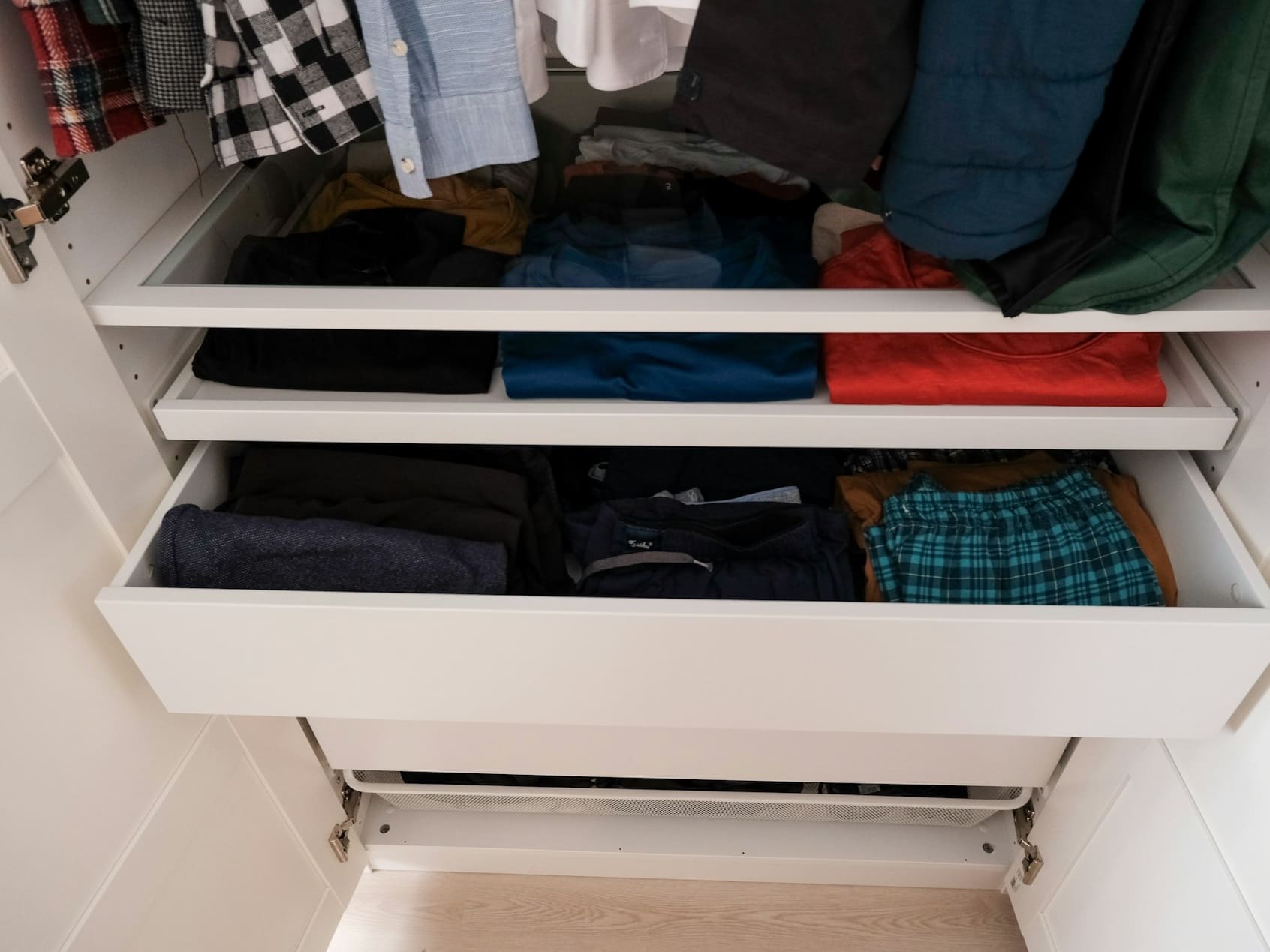
A bedroom often becomes the place where everything without another obvious home ends up. Clothes collect on a chair, nightstands fill with chargers and small items, seasonal bedding takes over useful wardrobe space, and the area under the bed becomes an unplanned hiding place.
The most useful bedroom storage ideas do not simply add more boxes, baskets, and furniture. A cleaner bedroom comes from giving everyday items the easiest access, moving seasonal belongings out of prime storage, using the space under the bed intentionally, and taking advantage of walls before adding another large piece of furniture.
A practical framework is:
Sort → prioritize → wardrobe → go low → go high → combine → secure → reset
Plan Bedroom Storage Around What You Use Most
Before buying another dresser or organizer, decide which belongings deserve the best storage locations.
Separate Daily, Occasional, and Seasonal Items
Items you use every day should be the easiest to reach.
These may include:
- Current clothing
- Sleepwear
- Phone charger
- Glasses
- Everyday accessories
Occasional items can move slightly farther away.
Examples include:
- Extra bedding
- Bags
- Special-occasion clothing
- Less-used accessories
Seasonal items should usually occupy lower-priority storage.
Examples include:
- Heavy blankets
- Off-season clothes
- Seasonal shoes
- Travel items
If something is used only a few times a year, it probably does not need the most convenient drawer in the room.
Remove Things That Don’t Belong
Before increasing storage capacity, remove items that would make more sense elsewhere.
Possible examples include:
- Old paperwork
- Empty packaging
- Household tools
- Unused electronics
- Excess décor
Adding another basket for things that should leave the bedroom does not solve the underlying problem.
Map the Storage You Already Have
Look around the room and identify:
- Wardrobe
- Drawers
- Nightstand
- Under-bed space
- Walls
- Alcoves
- Foot of the bed
- Behind doors where appropriate
You may already have unused capacity.
The goal is to make existing storage work better before adding another large unit.
Keep the Main Route Clear
Protect movement between:
- Door
- Bed
- Wardrobe
- Window
- Desk
- Hallway or bathroom
Storage should make the bedroom easier to use, not create an obstacle course.
Use Under-Bed Storage for Lower-Frequency Items
The space beneath the bed can provide useful storage without consuming additional floor area.
Choose the Right Categories
Good candidates may include:
- Off-season clothing
- Spare bedding
- Extra pillows
- Shoes
- Travel accessories
- Other low-frequency items
Under-bed storage works particularly well for things you do not need every morning.
Use Containers Instead of Loose Piles
Possible options include:
- Lidded boxes
- Fabric storage cases
- Divided containers
- Bed-specific drawers
Containers help you group similar belongings and pull them out without searching through a loose pile.
For example:
Box 1: winter clothing
Box 2: spare bedding
Box 3: travel items
That is much easier to maintain than one large mixed space.
Measure Before Shopping
Check:
- Height below the bed
- Bed-frame supports
- Available depth
- Clearance from the floor
- Whether you can access the space from the side or foot
Do not assume a storage box will fit just because it is marketed for under-bed use.
Label What You Cannot See Easily
Useful labels might include:
- Winter clothes
- Spare bedding
- Shoes
- Travel
Avoid a category called “miscellaneous.”
If you cannot describe what belongs in a box, the category is probably too broad.
Keep Frequently Used Items Somewhere Easier
If retrieving something requires:
- Moving furniture
- Lifting a mattress
- Crawling behind the bed
do not use that location for something you need daily.
Under-bed storage should reduce clutter, not make normal routines harder.
Make the Wardrobe Work Harder
A poorly organized wardrobe can make a bedroom feel as though it needs more furniture even when the real issue is the interior layout.
Divide the Wardrobe by Function
Create separate areas for:
- Hanging clothes
- Folded clothes
- Underwear
- Accessories
- Shoes
- Seasonal or backup items
Different categories usually benefit from different storage methods.
Give Daily Clothing the Best Access
Frequently worn pieces should stay:
- At comfortable height
- Toward the front
- In easy drawers or shelves
Occasional pieces can move:
- Higher
- Deeper
- Into boxes
This prevents low-frequency clothing from competing with your daily wardrobe.
Use Small Organizers Inside Large Spaces
A large wardrobe shelf or drawer can still become messy when it contains dozens of small items.
Use smaller boxes or dividers for:
- Socks
- Underwear
- Scarves
- Belts
- Small accessories
The goal is to stop categories from blending together.
Use Upper Storage for Low-Frequency Items
Higher wardrobe shelves are better suited to:
- Guest bedding
- Off-season clothing
- Bags
- Spare blankets
than to the shirt you wear several times a week.
Avoid Overfilling
A wardrobe is not functioning well if:
- Clothes are difficult to remove
- Items fall from shelves
- Drawers will not close
- Hanging garments are crushed together
Storage capacity is only useful when the contents remain accessible.
For more detailed wardrobe systems, see Closet Storage Ideas to Make Better Use of Every Inch and Closet Organization Ideas for a Cleaner, More Functional Closet.
Turn the Nightstand Into Useful Storage
A nightstand should support bedtime and morning routines rather than become a miniature junk drawer.
Keep the Top Simple
Useful everyday items may include:
- Lamp
- Phone
- Glasses
- Book
- Water
Everything else does not need to stay permanently visible.
Use a Drawer for Small Essentials
Possible drawer items include:
- Charging cables
- Earbuds
- Notebook
- Sleep accessories
- Other personal items
Medication should only be kept there when the bedroom conditions and location match its actual storage requirements.
Choose Closed Storage if Visual Clutter Is the Problem
A nightstand with a drawer or small cabinet can hide:
- Cables
- Tissues
- Personal items
while keeping them accessible.
Use a Wall Shelf in a Very Small Bedroom
If there is not enough room for a traditional bedside table, consider a suitable wall-mounted shelf.
This can provide enough space for:
- Lamp where appropriate
- Phone
- Book
- Glasses
without using additional floor area.
Check the shelf’s load rating and installation requirements before mounting it.
Avoid Oversized Nightstands
A bedside unit should not:
- Block wardrobe doors
- Narrow the route around the bed
- Crowd another piece of furniture
- Make bed access awkward
Choose the storage according to the actual room, not simply the largest nightstand you can fit.
Use Vertical Storage Before Adding More Furniture
Walls are especially valuable in a small bedroom.
Add Wall Shelves Where They Solve a Problem
Possible uses include:
- Books
- Small boxes
- Accessories
- Lightweight folded items where suitable
Use wall storage selectively rather than covering every wall.
Add Hooks for Temporary Clothing
Hooks can work well for:
- Robe
- Tomorrow’s outfit
- Bag
- Hat
This gives clothing a defined place without turning a chair into permanent storage.
Use Pegboards or Wall Organizers
These may suit:
- Jewelry
- Glasses
- Accessories
- Small personal items
They can be especially useful beside a bed or dresser where horizontal surface space is limited.
Use Tall Furniture Carefully
A tall wardrobe or shelving unit can add capacity without taking as much floor width.
However, tall or top-heavy furniture should be installed and secured according to the manufacturer’s anchoring instructions.
Do not treat height as free storage without considering stability.
Keep High Storage for Low-Frequency Items
Good candidates include:
- Seasonal clothes
- Spare bedding
- Travel bags
Daily essentials should not require repeated climbing or awkward reaching.
Use Benches and Multifunctional Furniture Carefully
In a limited bedroom, a furniture piece earns its space when it solves more than one genuine problem.
Consider a Storage Bench
A bench at the foot of the bed may provide:
- Extra bedding storage
- Shoe storage
- Bag storage
- Seating
This can work well when the room has enough clearance.
Consider a Storage Bed
A storage bed can use the existing bed footprint to hold larger belongings.
Depending on the design, it may reduce the need for another chest or cabinet.
Before buying one, check the exact manufacturer’s guidance for:
- Lifting mechanism
- Weight limits
- Mattress compatibility
- Required clearance
Check Whether Everything Can Still Open
Before adding multifunctional furniture, test whether:
- Bench lid can lift
- Wardrobe door can open
- Drawers can extend
- Bed storage can be accessed
A storage piece is not useful if other furniture has to be moved every time you need it.
Don’t Add a Bench Just Because It Fits
If the bench:
- Narrows circulation
- Duplicates storage
- Becomes a clothing pile
it is not helping.
Multifunctional furniture only works when both functions are genuinely useful.
Store Seasonal Clothing and Bedding Outside Prime Storage
Seasonal rotation is one of the easiest ways to free useful bedroom storage.
Clean Items Before Long-Term Storage
Follow the care labels for:
- Clothing
- Blankets
- Bedding
- Other textiles
This is particularly important for susceptible natural fibers when clothes-moth problems are a concern.
Do not store items with obvious dirt or staining and assume they will be easier to deal with months later.
Separate Seasonal Categories
Possible groups include:
- Winter clothing
- Summer clothing
- Seasonal shoes
- Spare bedding
This makes seasonal changeovers much easier.
Use Lower-Priority Storage
Possible locations include:
- Under the bed
- High wardrobe shelf
- Storage bed
- Nearby linen storage
Prime drawers should serve the current season.
Review Items During Each Rotation
When the season changes, ask:
- Does this still fit?
- Is it damaged?
- Do I still use it?
- Does it need cleaning?
- Should it return to prime storage?
Seasonal rotation is a useful opportunity to prevent unused belongings from building up.
Make a Small Bedroom Work With Less Furniture
Small bedrooms often become more difficult to use because storage is added piece by piece until little open floor space remains.
Improve Existing Storage First
Before adding:
- Another dresser
- Another cabinet
- Another basket
ask whether your:
- Wardrobe
- Bed
- Walls
can do more.
Move Bedside Storage Onto the Wall
Possible options include:
- Wall shelf
- Pegboard
- Small wall cabinet
- Hooks
This may free valuable space beside the bed.
Use the Bed Footprint
Under-bed boxes or built-in bed storage can hold items without introducing another large piece of furniture.
Consider Space-Efficient Door Systems
In a tight room, a storage unit whose doors do not require a wide swing area may sometimes be useful.
Measure the room and check the exact system rather than assuming one door type is always better.
Prefer Narrow or Tall Storage Where Appropriate
A taller unit can sometimes provide more capacity while using less floor width.
If the piece is tall or top-heavy, follow its anchoring requirements.
Keep Visible Surfaces Calm
In a small room, clutter on the:
- Nightstand
- Dresser
- Floor
- Open shelves
occupies a large percentage of what you see.
Closed storage can be particularly helpful for items that do not need to be displayed.
For more ideas, see Smart Storage Ideas for Small Spaces That Actually Reduce Clutter.
Keep Bedroom Storage Safe as You Add Height
Using wall space and taller furniture can improve storage, but installation matters.
Anchor Tall Furniture as Directed
Tall or top-heavy storage should be secured according to its manufacturer’s instructions and any supplied anti-tip system.
Use the Correct Fasteners
Wall construction differs.
Do not improvise:
- Anchors
- Screws
- Wall plugs
- Mounting methods
Follow the instructions for the furniture, shelf, and wall type.
Respect Load Ratings
Shelves, hooks, pegboards, and wardrobes all have specific limits.
Do not assume a shelf designed for lightweight objects can safely hold heavy storage boxes.
Access High Storage Safely
Do not climb:
- Drawers
- Shelving
- Storage furniture
to reach upper items.
High storage should remain occasional storage rather than something you need continuously.
Bedroom Storage Ideas at a Glance
| Bedroom Problem | Better Storage Approach | Best For | Watch Out For |
|---|---|---|---|
| Seasonal items fill the wardrobe | Under-bed or high storage | Clothes, bedding | Difficult access |
| Wardrobe feels full | Internal zones and smaller organizers | Clothing, accessories | Overfilling |
| Messy bedside area | Drawer or wall-mounted shelf | Chargers, glasses, books | Oversized nightstand |
| Little floor space | Vertical storage | Boxes, books, accessories | Anchoring and mounting |
| No place for spare bedding | Storage bench or bed | Blankets, pillows | Furniture access |
| Small accessories disappear | Divided boxes | Socks, jewelry, belts | Catch-all bins |
| Seasonal clothing crowds drawers | Labeled rotation storage | Off-season clothes | Poor textile preparation |
| Small bedroom has too much furniture | Multifunctional storage | Several categories | Blocking movement |
| Tall furniture feels unstable | Proper anchoring | Wardrobes, dressers | Incorrect fasteners |
| Surfaces constantly cluttered | Closed storage + defined daily zone | Personal items | Hiding unsorted clutter |
Good bedroom storage should make frequently used belongings easier to reach and easier to put away, not simply create more places where things can disappear.
Common Bedroom Storage Mistakes
Turning Under-Bed Space Into a Junk Drawer
Use containers and defined categories.
Keeping Seasonal Clothing in Prime Storage
Move off-season items when they are not needed.
Buying Another Dresser Too Soon
Improve the wardrobe, walls, and bed storage first.
Using the Nightstand as a Catch-All
Keep it focused on bedtime and morning routines.
Installing Too Much Open Shelving
Open storage increases capacity but also puts everything on display.
Mix open and closed storage according to what you actually want to see.
Putting Daily Items Too High
High shelves are better for lower-frequency categories.
Buying Containers Before Measuring
Measure:
- Wardrobe shelves
- Under-bed clearance
- Drawers
- Wall space
- Bench interior
before ordering organizers.
Blocking Doors or Drawers
Always test whether:
- Wardrobe doors open
- Drawers extend
- Bed storage lifts
- Room doors move freely
Adding a Bench That Becomes a Clothing Pile
A storage bench should have a defined function.
Ignoring Furniture Stability
Tall furniture should be installed and anchored according to the product instructions.
Storing Seasonal Textiles Without Preparing Them
Clean appropriate textiles before long-term storage according to their care requirements.
Organize Bedroom Storage in the Right Order
If the room already feels cluttered, use this sequence.
Step 1: Remove What Doesn’t Belong
Move unrelated household items elsewhere.
Step 2: Group What Remains
Possible categories include:
- Everyday clothes
- Occasional clothing
- Bedding
- Shoes
- Accessories
- Seasonal items
- Nightstand essentials
Step 3: Identify Prime Storage
Reserve the easiest:
- Wardrobe sections
- Drawers
- Bedside storage
for frequent use.
Step 4: Improve the Wardrobe
Use an appropriate combination of:
- Rails
- Shelves
- Drawers
- Small boxes
according to what you own.
Step 5: Use Under-Bed Space
Move lower-frequency categories into measured containers.
Step 6: Simplify the Nightstand
Keep only bedtime essentials nearby.
Step 7: Use the Walls
Add suitable:
- Hooks
- Shelves
- Organizers
where they solve an actual storage problem.
Step 8: Consider Multifunctional Furniture
Use a storage bench or storage bed only when there is enough space to operate it comfortably.
Step 9: Move Seasonal Items
Free the best storage for the current season.
Step 10: Check Safety
Review:
- Tall furniture
- Wall-mounted storage
- Anchoring
- Fasteners
- Load limits
Step 11: Test the Room
Ask:
- Can all doors open?
- Can drawers extend fully?
- Can you walk around the bed?
- Can daily items be put away easily?
Remember:
Sort → prioritize → wardrobe → go low → go high → combine → secure → reset
Maintain a Cleaner Bedroom With a Simple Reset
The best storage system is one you can restore without another major organizing project.
Give Worn-but-Not-Dirty Clothes a Defined Place
Instead of using a chair as permanent clothing storage, choose one controlled location where appropriate.
Reset the Nightstand
Return:
- Chargers
- Books
- Glasses
- Personal items
to their assigned spaces.
Put Clean Laundry Away
Storage cannot work if clean clothing remains on the:
- Bed
- Chair
- Floor
for days.
Reset the Wardrobe When It Becomes Hard to Use
Warning signs include:
- Drawers no longer closing easily
- Clothes becoming difficult to remove
- Items falling from shelves
- Seasonal belongings moving back into prime storage
Rotate With the Seasons
Use each seasonal change to review:
- Clothes
- Shoes
- Bedding
- Storage containers
Small resets are easier than starting over.
Frequently Asked Questions About Bedroom Storage
What Are the Best Bedroom Storage Ideas for a Small Room?
Start with:
- Under-bed storage
- Better wardrobe organization
- Wall-mounted bedside storage
- Hooks
- High shelves
- Multifunctional furniture
Use the existing bed, walls, and wardrobe before adding another large storage piece.
What Should I Store Under the Bed?
Good candidates include lower-frequency items such as:
- Seasonal clothing
- Spare bedding
- Shoes
- Travel items
Use organized containers instead of loose piles.
How Can I Get More Storage From My Wardrobe?
Divide the wardrobe into:
- Hanging zones
- Shelves
- Drawers
- Small boxes
- Accessory storage
Keep everyday clothing in the easiest areas.
How Do I Keep My Nightstand From Getting Cluttered?
Limit the top to genuine bedtime essentials.
Move smaller items into a:
- Drawer
- Small container
- Nearby wall-mounted storage area
Is Vertical Storage Good for Small Bedrooms?
Yes, when installed properly.
Wall shelves, hooks, pegboards, and taller storage can increase capacity without consuming as much floor area.
Follow the exact mounting and anchoring instructions.
Is a Storage Bench Worth It?
It can be if it provides:
- Useful seating
- Useful storage
without narrowing the room or becoming a permanent clothing pile.
How Should I Store Seasonal Clothes?
Clean items according to their care labels, group them by season or category, and move them to lower-priority storage such as:
- Under-bed cases
- High wardrobe shelves
- Storage beds
- Other appropriate closed storage
Do I Need More Furniture to Get More Bedroom Storage?
Not necessarily.
First improve:
- Wardrobe interior
- Under-bed space
- Walls
- Existing multifunctional furniture
before adding another dresser or cabinet.
Conclusion
The best bedroom storage ideas are not about filling every gap with more storage products.
They are about assigning each category the right level of access.
Use:
Sort → prioritize → wardrobe → go low → go high → combine → secure → reset
Keep everyday items in prime storage. Move seasonal belongings out of the easiest wardrobe zones. Use the space under the bed for lower-frequency categories, and improve the wardrobe before buying another large piece of furniture.
Keep nightstand storage focused on bedtime essentials. Use walls and vertical space where the room is tight, and choose storage benches or beds only when both functions genuinely help.
Measure before buying organizers, preserve clear routes through the room, and follow manufacturer instructions when anchoring or mounting taller storage.
Most importantly, make the system easy to reset.
Start with three places: the wardrobe, the space under the bed, and the nightstand. Sort everything there into daily, occasional, and seasonal categories before adding any new storage furniture.