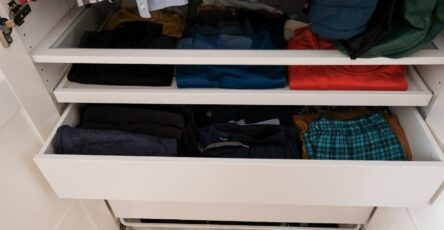

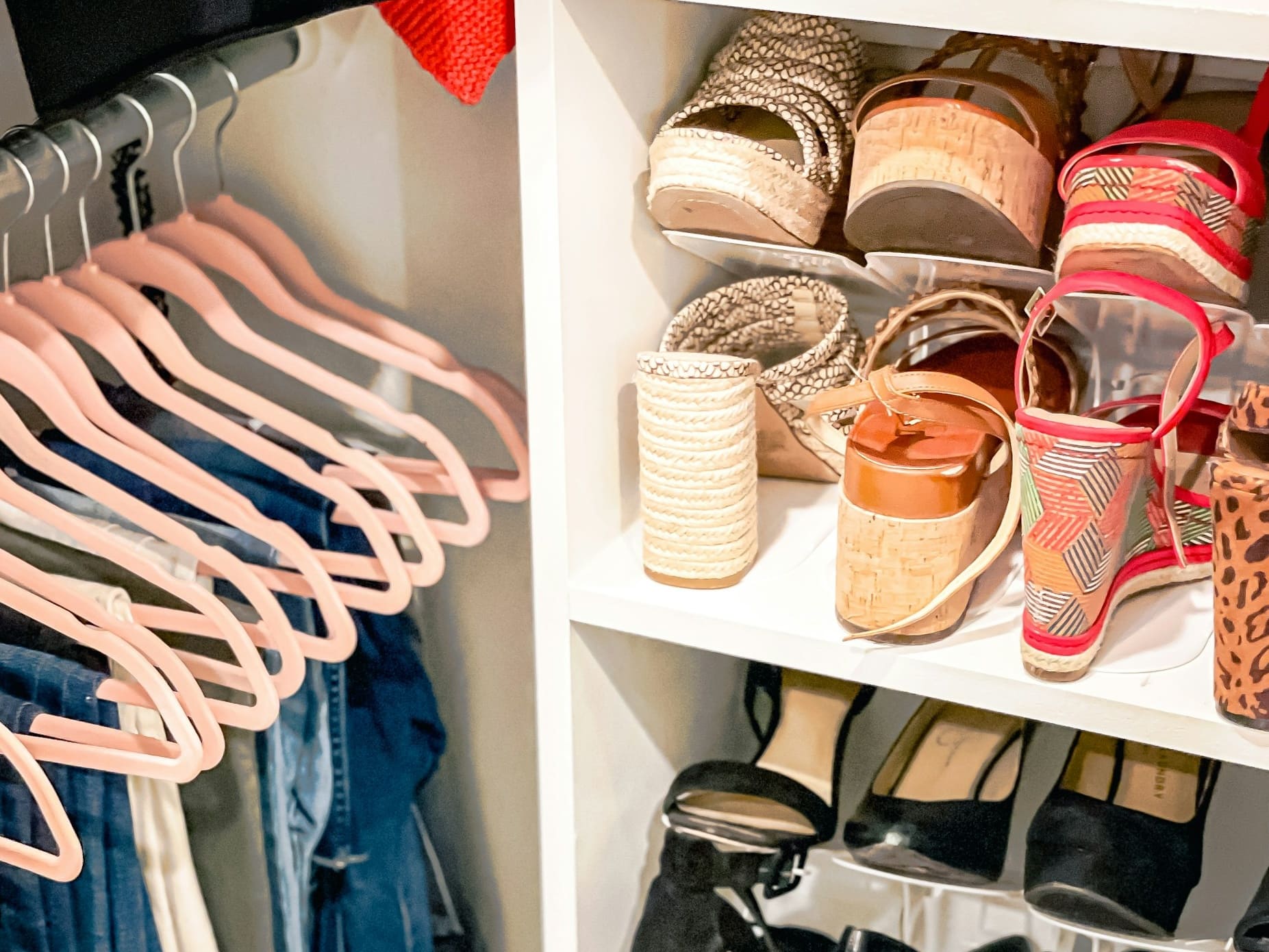
A closet can feel completely full while still wasting a surprising amount of usable space. Shirts may hang above an empty floor, one high shelf holds a few random boxes, shoes pile up near the door, and the back corner becomes a place where things disappear.
The best closet storage ideas do not simply squeeze more belongings into the same area. A better system uses the closet’s height, shelves, doors, floor, and corners in ways that keep your clothes visible, reachable, and easy to put away.
A practical approach is:
Measure → sort → hang → shelf → contain → go vertical → rotate → adjust
Before buying organizers, look at what you actually own and how each category needs to be stored. A closet filled mostly with shirts needs a different layout from one filled with long dresses, shoes, or folded knitwear.
Measure the Closet Before Adding Organizers
The first step is understanding the space you already have.
Measure the Whole Closet
Record:
- Width
- Height
- Depth
- Door opening
- Existing shelf positions
- Hanging-rod positions
Also note anything that reduces usable space, including:
- Sloped ceilings
- Recesses
- Baseboards
- Pipes
- Radiators or vents
- Door hinges
- Sliding-door overlap
Do not rely on the outside dimensions of the closet. What matters is the usable interior space after doors, shelves, and obstructions are considered.
Sort What You Own by Storage Type
Instead of looking at everything as simply “clothes,” divide the contents into practical categories:
- Short hanging clothes
- Long hanging clothes
- Folded clothes
- Shoes
- Bags
- Accessories
- Seasonal items
This makes it easier to decide whether you need:
- More hanging space
- More shelving
- Shoe storage
- Bins
- High-level storage
For example, a closet containing mostly shirts, skirts, and folded jeans may benefit greatly from double hanging and shelves. A wardrobe containing several long coats and dresses needs more uninterrupted hanging height.
Remove What Does Not Need Prime Space
Before expanding storage capacity, remove obvious space-wasters such as:
- Broken hangers
- Empty packaging
- Bags you no longer use
- Clothes that belong elsewhere
- Items you no longer wear
You do not need to turn the project into a full decluttering session. The goal is simply to avoid designing new storage around things that no longer deserve closet space.
For a broader sorting system, Mellora’s Closet Organization Ideas for a Cleaner, More Functional Closet can help with the organization side while this guide focuses on physical storage.
Use Double Hanging for Short Clothes
One of the easiest ways to reclaim vertical space is to add a second hanging level where garment length allows.
How Double Hanging Works
A traditional closet often has:
- One rod
- Short clothes hanging from it
- A large unused area below
Double hanging divides that same vertical zone into:
- Upper rod
- Lower rod
This can substantially improve hanging efficiency when most garments are relatively short.
Good Candidates for Double Hanging
Depending on garment length, double hanging may work well for:
- Shirts
- Blouses
- Folded-over trousers
- Short jackets
- Skirts
- Children’s clothes
Measure your own garments rather than assuming a standard rod position will work.
Keep a Full-Height Hanging Section
Do not convert the entire closet into double hanging.
Preserve a tall section for:
- Dresses
- Long coats
- Robes
- Other long garments
Adding more rods is only useful if the clothes still fit properly.
Measure Before Positioning Rods
Check:
- Actual garment drop
- Rod system instructions
- Shelf position
- Your reach
- Clearance above the floor
Rod height, span, mounting, and load capacity depend on the actual closet system.
Add Shelves Where Hanging Is Not the Best Use
Some clothes and accessories store better folded than hung.
Use Shelves for Folded Categories
Shelves can work well for:
- Sweaters
- Jeans
- Sweatshirts
- Handbags
- Hats
- Storage boxes
This can free hanging rods for clothing that genuinely benefits from being hung.
Add Another Level When Shelf Height Is Wasted
A common closet problem looks like this:
Tall shelf opening + short pile of folded clothes = unused vertical space.
Possible solutions include:
- Additional adjustable shelf
- Shelf insert
- Stackable organizer
The goal is to reduce wasted height without making items difficult to remove.
Match Shelf Spacing to What You Store
You do not need every shelf to have identical spacing.
You might use:
- Shorter spacing for folded shirts
- Medium spacing for sweaters
- Taller spacing for handbags
- Dedicated space for bins
Adjustable shelving is especially useful because your wardrobe may change over time.
Avoid Tall, Unstable Clothing Stacks
A shelf that holds one huge stack of clothes may technically be full, but retrieving the bottom item becomes frustrating.
Try:
- Shorter stacks
- Shelf dividers
- Pull-out baskets
- Category bins
Good storage should make returning an item almost as easy as taking it out.
Use the Highest Space for Low-Frequency Items
Upper closet space is valuable, but it is less convenient.
That makes it ideal for things you do not need every day.
Move Occasional Items Up
Good candidates include:
- Seasonal clothes
- Spare bedding
- Occasion accessories
- Travel bags
- Extra linens
Keep everyday shirts and shoes in easier-to-reach zones.
Use Containers Instead of Loose Piles
High shelves become much easier to manage when items are grouped into:
- Lidded boxes
- Storage cases
- Bins with handles
Instead of removing several loose items one by one, you can bring down one complete category.
Label What You Cannot See
Useful labels might include:
- Winter sweaters
- Swimwear
- Occasion bags
- Spare bedding
Opaque boxes should not turn into mystery storage.
Keep Heavy Items Lower
Avoid placing heavy containers at ceiling height simply because space exists.
Consider:
- Shelf capacity
- Container weight
- Your reach
- How safely the item can be retrieved
The least accessible storage should usually contain lighter, less frequently used items.
Use Closet Doors as Extra Storage
The inside or back of a closet door can provide useful shallow storage without taking up shelf or floor space.
Add Hooks for Light Everyday Items
Over-door or compatible door-mounted hooks may work for:
- Bags
- Robes
- Hats
- Tomorrow’s outfit
They can be especially useful when closet wall space is limited.
Use Pocket Organizers for Small Categories
Hanging pocket organizers can hold:
- Shoes
- Scarves
- Small bags
- Accessories
This can free up shelf and floor space.
Check the Door Before Buying Anything
Verify:
- Door thickness
- Clearance above the door
- Frame clearance
- Whether the door can still close fully
- Whether the organizer hits the wall
- Product load limits
An organizer that prevents the closet door from closing is not useful storage.
Avoid Overloading the Door
Door storage works best for relatively light categories.
Too many heavy objects can make the door harder to use and may exceed the organizer or hardware limits.
Use Bins for Small and Difficult Categories
Bins are useful when they contain a clear category.
They become less useful when they turn into places where miscellaneous items disappear.
Use Bins for Accessories
Possible categories include:
- Scarves
- Gloves
- Belts
- Swimwear
- Socks
- Small bags
Give each category its own container when that improves access.
Use Open Bins for Everyday Items
Open storage works well for items you use regularly, such as:
- Workout clothing
- Everyday bags
- Frequently used accessories
You can see and grab the contents without opening a lid.
Use Closed Containers for Seasonal Items
Closed bins can work better for:
- Off-season clothing
- Occasion accessories
- Less-used textiles
They keep these items together without occupying prime everyday storage.
Measure Before Buying Bins
Check:
- Width
- Depth
- Height
- Handle clearance
A large bin that wastes shelf depth or blocks access may hold less effectively than several smaller ones.
Label Opaque Storage
If you cannot see through the container, label it.
A bin marked Winter Accessories is far more useful than a box you have to open every time you forget what is inside.
Organize Shoes Without Losing the Entire Floor
Shoes often consume more closet space than expected because they end up scattered across the floor.
Divide Shoes by Use
Separate:
- Everyday shoes
- Occasion shoes
- Boots
- Seasonal footwear
The pairs you wear most often should be easiest to reach.
Use Low Shoe Storage
Possible options include:
- Floor rack
- Flat shelf
- Angled shoe shelf
- Stackable shoe organizer
The best option depends on your available height and shoe collection.
Use Door Storage Where It Fits
Smaller shoes may fit well in an over-door organizer when:
- The door supports the organizer
- Pocket dimensions are suitable
- Clearance allows the door to close
Give Boots More Height
Boots need more vertical room than low shoes.
Do not design the entire shoe zone around sneakers and then discover there is nowhere for boots.
Avoid Unstable Towers
Vertical storage is useful only when it remains stable and accessible.
If lower shoes require dismantling the whole stack, the system is too dense.
Store Seasonal Clothing Outside Prime Space
Seasonal items can consume valuable everyday storage even when they are not needed for months.
Move Off-Season Clothes Higher
Examples include:
- Heavy coats
- Knitwear
- Swimwear
- Scarves
- Seasonal accessories
Use:
- Top shelves
- Closed bins
- Less-accessible side zones
Clean and Inspect Before Long-Term Storage
Before storing seasonal clothes, especially woolens and other susceptible natural fibers:
- Check for dirt
- Inspect for pest activity
- Clean according to the garment care label
- Store appropriately
Clean storage and good housekeeping can help reduce clothes-moth problems.
Clean the Closet Too
Before storing valuable textiles, check:
- Shelf edges
- Corners
- Floor
- Baseboards
Vacuuming hidden areas can remove lint, hair, and debris that accumulate where clothing is stored.
Label More Specifically Than “Winter”
Instead of one broad box marked Winter, consider:
- Winter sweaters
- Winter accessories
- Occasion coats
You will find what you need much faster.
Rotate Rather Than Reorganize
When seasons change:
- Bring current clothes into prime storage.
- Clean and inspect the outgoing season.
- Move those items into their assigned containers.
- Reconsider pieces you did not wear.
You do not need to rebuild the whole closet every season.
Use Vertical Space From Floor to Ceiling
Many closets are designed around one rod and one shelf even though usable space continues far above and below both.
Use the Space Above the Rod
Possible uses include:
- Upper shelf
- Seasonal boxes
- Handbags
- Spare bedding
Keep lower-frequency items higher.
Use the Space Below Short Clothes
Depending on your wardrobe, this area can hold:
- Second hanging rod
- Shoe shelving
- Drawers
- Bins
Do not automatically leave a large empty floor zone under shirts.
Add Narrow Hanging Organizers
A hanging compartment organizer can convert part of a rod into vertical shelf space.
It can hold:
- Knitwear
- Bags
- Folded clothes
- Accessories
This is especially useful when permanent shelving is not practical.
Consider Above-Door Space
Some closets have an unused area above the door.
Where appropriate and safely installed, an upper shelf may hold low-frequency items.
Any added shelf must be mounted according to the shelf, fastener, and wall requirements.
Make Awkward Corners Work Harder
Closet corners often contain plenty of volume but poor access.
The solution is not always to fill them.
Ask Whether the Corner Is Truly Reachable
Consider:
- Can you see into it?
- Can you reach it comfortably?
- Will hanging clothes block access?
- Does the door interfere?
If everyday access is difficult, do not store everyday clothes there.
Use Corner Shelves
Where the layout allows, corner shelving can hold:
- Folded clothing
- Handbags
- Boxes
- Accessories
A purpose-built corner unit may use the area more effectively than two shelves that collide.
Use Difficult Corners for Less-Frequent Items
Good choices include:
- Occasion bags
- Seasonal bins
- Spare bedding
These categories do not need prime access.
Use Hooks in Narrow Gaps
Small side spaces may still work for:
- Belts
- Scarves
- Bags
- Hats
A narrow area that cannot hold a shelf may still support useful shallow storage.
Avoid Deep Corner Piles
If you need to remove six objects to retrieve one, the corner has become storage volume rather than usable storage.
Keep Everyday Items in the Easiest Zones
A closet can hold more while becoming harder to use.
Capacity and usability are not the same thing.
Create Three Access Levels
Prime Zone
Use for:
- Daily clothes
- Everyday shoes
- Frequently used bags
Secondary Zone
Use for:
- Less-used clothing
- Occasion pieces
- Accessories
High or Deep Zone
Use for:
- Seasonal clothing
- Backups
- Rare-use items
Don’t Waste Prime Space on Seasonal Boxes
A large off-season container at eye level may force daily clothes into harder-to-reach areas.
Move frequency and accessibility together.
Keep Similar Items Together
Simple categories are often enough:
- Shirts
- Trousers
- Shoes
- Bags
There is no need to color-coordinate the entire closet unless that genuinely makes it easier for you to use.
Closet Storage Ideas at a Glance
| Closet Problem | Practical Storage Idea | Best For | Watch Out For |
|---|---|---|---|
| Large gap below shirts | Add second hanging rod | Shirts, trousers, skirts | Garment length and rod load |
| Too much unused shelf height | Add shelf or insert | Folded clothes, bags | Shelf capacity |
| Empty door back | Hooks or pocket organizer | Bags, shoes, accessories | Door clearance and load |
| Small accessories disappear | Labeled bins | Scarves, belts, gloves | Mystery bins |
| Shoes cover the floor | Shoe shelf or rack | Everyday footwear | Boots and large shoes |
| Seasonal items use prime space | Labeled upper boxes | Off-season clothing | Access and weight |
| High ceiling goes unused | Upper shelving | Low-frequency items | Safe reach |
| Short clothes leave floor empty | Shoes, drawers, or bins below | Mixed storage | Overcrowding |
| Awkward corner | Corner shelf or low-frequency bin | Bags, folded items | Poor access |
| Fixed system no longer fits | Adjustable shelves or rods | Changing wardrobe needs | Hardware compatibility |
The best closet layout uses each area according to both item size and frequency of use, rather than trying to fill every available gap.
Common Closet Storage Mistakes
Buying Organizers Before Measuring
A deep bin that blocks the door or a rack that does not fit the floor adds no useful capacity.
Using One Hanging Rod for Everything
Short garments can leave a large amount of vertical space unused.
Double Hanging Every Section
You still need room for long garments.
Creating Huge Folded Stacks
If lower items cannot be reached easily, reduce the stack height.
Putting Everyday Items Too High
Prime storage should serve your daily routine.
Overloading the Door
Door organizers need proper clearance and suitable load capacity.
Leaving Shoes in One Floor Pile
This makes pairs difficult to see and wastes low-level storage.
Using Unlabeled Opaque Bins
Closed storage becomes frustrating when you cannot remember what is inside.
Storing Seasonal Clothes Without Cleaning Them
Inspect and clean garments before long-term storage, particularly susceptible natural fibers.
Putting Heavy Boxes Too High
Upper storage should remain safe to access.
Using Awkward Corners for Daily Clothes
Difficult spaces are generally better for lower-frequency items.
Guessing Weight Limits
Rod, shelf, hook, and organizer capacity depends on the exact product and how it is installed.
Improve Closet Storage in the Right Order
If you want to redesign the closet without rebuilding everything, use this sequence.
Step 1: Measure
Record:
- Width
- Height
- Depth
- Door clearance
- Obstructions
Step 2: Sort by Storage Type
Create groups for:
- Short hang
- Long hang
- Fold
- Shoes
- Accessories
- Seasonal
Step 3: Protect Long-Hanging Space
Reserve enough uninterrupted height for dresses, coats, and other long garments.
Step 4: Double Hang Short Clothing
Add a second level only where garment length allows.
Step 5: Improve Shelves
Add or reposition shelves where large vertical gaps are being wasted.
Step 6: Organize Shoes
Choose floor, shelf, or door storage according to the available space.
Step 7: Add Bins
Contain small categories and label opaque storage.
Step 8: Use the Door
Add selective hooks or pockets if clearance allows.
Step 9: Move Seasonal Items Higher
Reserve prime storage for what you use now.
Step 10: Solve Awkward Corners
Use:
- Shelves
- Hooks
- Low-frequency containers
instead of random piles.
Step 11: Test Access
Ask:
- Can I see the category?
- Can I retrieve one item without unloading another?
- Can I put it back easily?
Step 12: Adjust
After using the closet for a while, change shelf positions, bin assignments, or hanging zones where needed.
Remember:
Measure → sort → hang → shelf → contain → go vertical → rotate → adjust
Maintain Closet Storage Without Starting Over
A useful closet system should survive normal daily use.
Return Items to Their Zones
Shoes should return to shoe storage.
Bags should return to their shelf or hooks.
Accessories should return to their bin.
A system fails quickly if every category starts collecting on the floor.
Reset High-Traffic Areas
Focus on:
- Floor
- Everyday hanging
- Shoe storage
- Door hooks
You do not need to empty the entire closet whenever one area gets messy.
Rotate Seasonally
When the season changes:
- Move current clothes into easier reach.
- Clean and inspect off-season pieces.
- Store them in designated containers.
- Reassess what was never worn.
Clean Hidden Areas
Vacuum or clean:
- Floor
- Corners
- Shelf edges
- Baseboards
particularly where natural-fiber clothes are stored.
Reconfigure Before Buying More
If one category grows while another shrinks, adjust:
- Shelf spacing
- Rod configuration
- Bin allocation
before adding another organizer.
A flexible closet is usually easier to maintain than one packed permanently to maximum capacity.
For broader small-space strategies, see Smart Storage Ideas for Small Spaces That Actually Reduce Clutter.
Frequently Asked Questions About Closet Storage
What Are the Best Closet Storage Ideas for a Small Closet?
Start with vertical space.
Depending on what you own, consider:
- Double hanging
- Additional shelves
- Door storage
- Low shoe racks
- Labeled upper bins
- Hanging compartment organizers
Choose only the solutions that match your wardrobe.
How Do I Create More Hanging Space?
If most of your clothes are short enough, divide part of the closet into upper and lower hanging zones.
Keep a separate full-height section for dresses, coats, and long garments.
What Should Go on the Top Shelf?
Good candidates include:
- Seasonal clothes
- Spare bedding
- Occasion accessories
- Travel bags
Avoid putting heavy objects high up unless the storage and retrieval method are suitable.
How Should I Store Shoes in a Small Closet?
Depending on the layout, use:
- Low shoe rack
- Shoe shelves
- Stackable organizers
- Door pockets
Keep everyday pairs easiest to reach.
Are Over-Door Organizers Useful?
They can be, particularly for shallow categories such as:
- Shoes
- Bags
- Scarves
- Accessories
Check door thickness, top clearance, closing clearance, and load limits before buying.
How Should I Store Seasonal Clothes?
Clean and inspect the clothing first, then move it into a lower-frequency zone such as:
- Labeled upper bin
- Closed storage case
- Less-accessible shelf
What Can I Do With an Awkward Closet Corner?
Possible solutions include:
- Corner shelves
- Hooks
- Narrow organizer
- Seasonal bins
- Occasion bags
Use difficult corners for items that do not require daily access.
Is Double Hanging Always Better?
No.
Double hanging works best for shorter garments. If your wardrobe contains many long coats, dresses, or robes, you need full-height hanging too.
Conclusion
The best closet storage ideas are not about forcing the greatest possible number of belongings into one space.
They are about using hanging height, shelves, doors, floor space, upper areas, and awkward corners without making your wardrobe difficult to see or reach.
Use this sequence:
Measure → sort → hang → shelf → contain → go vertical → rotate → adjust
Measure before buying organizers. Divide clothes according to how they need to be stored. Use double hanging where short garments leave wasted space, but protect enough full-height hanging for long clothing.
Add shelves where large vertical gaps serve no purpose. Use doors selectively for shallow storage, and give small accessories clear bins instead of letting them scatter through the closet.
Keep shoes organized at lower levels, move seasonal clothing out of prime reach, and use the highest spaces for lighter, low-frequency categories.
Treat awkward corners carefully. A corner filled with objects you cannot reach is not useful storage simply because the space is occupied.
Most importantly, keep the system flexible. As your wardrobe changes, adjust shelves, hanging zones, and bin categories instead of automatically buying more organizers.
Start by measuring one closet and dividing everything inside into six groups: short hang, long hang, fold, shoes, accessories, and seasonal. Once you know how much space each category really needs, the best storage improvements become much easier to see.