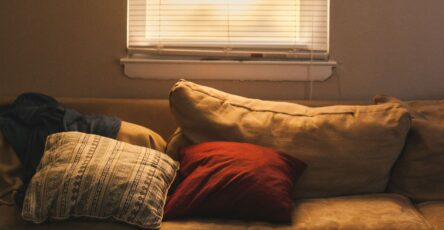


An empty wall can make a room feel unfinished, but adding décor does not automatically solve the problem. A tiny frame may disappear above a large sofa, a gallery wall can become visually crowded, and a mirror or shelf can feel disconnected if its size has no relationship to the furniture around it.
The best wall décor ideas begin with proportion. The goal is not simply to fill the wall. It is to choose a composition that fits the scale of the room, relates to nearby furniture, and gives the wall a clear purpose.
A useful decorating sequence is:
Wall → furniture → scale → composition → spacing → mounting → edit
Once those pieces work together, even a simple mirror, textile, or single artwork can feel intentional.
Start With Proportion Before Choosing Wall Décor
Before deciding between a gallery wall, oversized canvas, shelf, or mirror, look at the wall and the room around it.
Look at the Wall and Furniture Together
Consider what sits below or near the empty wall:
- Sofa
- Bed
- Console
- Sideboard
- Desk
- Dining table
- Fireplace
- Open floor area
A piece hanging above substantial furniture should normally feel visually connected to it rather than floating as a separate object.
For example, a very small frame above a wide sofa may technically be centered but still feel undersized. A wider artwork or gallery composition can create a stronger relationship between the furniture and wall.
Think About Visual Weight
Physical dimensions are only part of scale.
A wall piece can feel visually heavier because it uses:
- Dark colors
- Bold contrast
- Thick frame
- Wide mat
- Strong pattern
- Sculptural depth
- Heavy-looking textile
Likewise, several smaller frames can work together as one larger visual feature.
This is why two pieces of exactly the same dimensions can have very different impacts in a room.
Use Furniture Width as a Starting Reference
One designer guideline published by Architectural Digest suggests artwork or mirrors measuring roughly 60–75% of the width of the furniture below as a useful starting point.
Treat that as guidance rather than a fixed decorating law.
The right proportion can change because of:
- Ceiling height
- Wall width
- Furniture design
- Architecture
- Frame style
- Gallery layout
- Deliberately oversized artwork
If you create a gallery wall, judge its entire outer footprint rather than the width of each individual frame.
Don’t Assume a Small Room Needs Tiny Art
A compact room does not automatically require miniature décor.
One substantial artwork can actually create a simpler composition than several small pieces spread around the wall.
Instead of six unrelated frames in a small bedroom, one large photograph or painting may create a clearer focal point.
Decide Between One Statement Piece and a Collection
Before choosing what to hang, decide what the wall needs.
Choose One Large Piece When You Want Simplicity
A single large focal point can work well when the wall:
- Is broad and visually simple
- Sits above substantial furniture
- Already shares the room with other decorative elements
- Needs one obvious anchor
Possible choices include:
- Oversized painting
- Large photograph
- Large textile
- Large mirror
This approach can make a room feel calmer because the eye has one dominant feature to focus on.
Choose a Collection When You Have Smaller Pieces
A gallery arrangement works well for:
- Family photos
- Travel prints
- Small artworks
- Collected illustrations
- Textiles
- Mixed media
- Meaningful personal pieces
The important point is to treat the entire collection as one large composition.
Choose Functional Décor When the Wall Needs More Than Decoration
Some walls also need to provide:
- Display space
- Light reflection
- Flexible styling
- Storage
In that case, consider:
- Mirror
- Floating shelf
- Picture ledge
The best wall décor does not always need to be traditional artwork.
Use Oversized Art for a Clear Focal Point
Large artwork is one of the simplest ways to decorate an empty wall because one piece can establish the scale of the whole area.
Let One Piece Carry the Wall
Oversized artwork works especially well:
- Above a sofa
- Above a bed
- In a dining room
- At the end of a hallway
- On a large uninterrupted living-room wall
The main advantage is clarity.
Rather than trying to coordinate several smaller objects, one substantial piece gives the wall a clear center.
Use Large Artwork in Small Rooms Too
Oversized artwork is not only for spacious interiors.
In a smaller room, one strong piece can reduce visual fragmentation.
For example:
- One large photograph in a bedroom
- One abstract canvas above a compact sofa
- One bold artwork at the end of a narrow room
can be more effective than several tiny decorations.
Relate the Art to the Furniture
Before hanging it, compare:
- Artwork width
- Furniture width
- Wall height
- Frame thickness
- Surrounding negative space
The artwork does not need to match the furniture dimensions exactly, but the two should feel visually related.
Let Large Art Breathe
If one piece already has enough visual presence, resist surrounding it with:
- Tiny frames
- Signs
- Shelves
- Extra wall accessories
Empty wall around the artwork can make it stronger.
Create a Gallery Wall That Feels Like One Feature
Gallery walls are ideal when you have several pieces you want to display, but they work best when the layout is planned before anything is mounted.
Choose Between Structured and Organic Layouts
Structured gallery
This works well with:
- Matching frames
- Photography series
- Minimal rooms
- Equal-size prints
Typical arrangements include:
- Two-by-two grid
- Three frames in a row
- Symmetrical group
Aligned edges and consistent gaps help the group feel organized.
Organic gallery
This suits:
- Mixed frame sizes
- Collected art
- Personal photographs
- Textiles
- Different media
The layout can be more relaxed while still having a clear overall shape.
Plan the Whole Gallery Shape
Do not judge frames one by one.
Instead, consider how the full group relates to:
- Sofa width
- Console width
- Wall width
- Staircase angle
- Nearby architecture
The gallery should function like one large wall object.
Lay Everything Out First
Before mounting:
- Arrange your frames on the floor.
- Try several compositions.
- Move pieces until the balance feels right.
- Photograph the finished arrangement.
- Recreate it on the wall.
Another method is to trace each frame onto paper.
Then:
- Cut out the paper shapes.
- Tape them temporarily to the wall.
- Adjust spacing.
- Check the layout from across the room.
- Mark final mounting locations only when everything feels balanced.
Start With the Strongest Piece
For a loose gallery arrangement:
- Position the largest or strongest piece first.
- Add medium-size pieces around it.
- Fill remaining gaps with smaller frames.
This gives the arrangement a visual anchor.
Create Cohesion Without Making Everything Match
Repeat one or two elements:
- Frame finish
- Mat color
- Color palette
- Subject
- Photography style
For example, a gallery can combine travel photos, typography, and illustrations if all of the frames are black.
Keep Gallery Wall Spacing Consistent
Spacing can make the difference between a collection that feels intentional and one that looks randomly scattered.
Use One Spacing Logic
You do not need one universal measurement.
Instead:
- Keep similar gaps between related pieces.
- Avoid one unexpectedly large gap in the middle.
- Keep the group visually connected.
There is no need to force a fixed two-inch or three-inch rule onto every wall.
Treat Small Frames as a Cluster
If small frames are spread too widely apart, they stop functioning as a group.
Bring them close enough visually that the eye reads them as one composition.
Give Large Pieces More Space
An oversized canvas can usually tolerate more empty wall around it.
Negative space is part of the design.
Step Back Before Finalizing
A layout that seems balanced while you are standing close to the wall may look completely different from across the room.
Check it from:
- Doorway
- Sofa
- Dining table
- Main walking path
before committing.
Use Mirrors for Light, Depth, and Function
Mirrors can solve a different problem from artwork because they interact with the room itself.
Use a Mirror to Reflect Available Light
A mirror can reflect existing light back into the room, making the area appear brighter and more visually open.
This can be especially useful in:
- Entryways
- Living rooms
- Dining rooms
- Bedrooms
Let a Large Mirror Become the Main Feature
A substantial mirror can replace artwork over:
- Console
- Sideboard
- Vanity
- Entry table
- Suitable fireplace wall
Treat its size like you would treat a large artwork.
It should relate to the furniture below rather than appearing disconnected.
Check the Reflection Before Hanging It
Stand where the mirror will go and look at what it will reflect.
Possible reflections include:
- Window
- Artwork
- Lighting
- Another mirror
- Hallway
- Clutter
A beautiful mirror can still be poorly placed if it mainly reflects something you would rather not emphasize.
Group Smaller Mirrors
Several smaller mirrors can form a gallery-style composition.
To keep them cohesive, repeat:
- Frame finish
- Shape
- Material
- Color
Mount Mirrors for Their Actual Weight
Large mirrors can be heavy.
Choose mounting hardware according to:
- Mirror weight
- Wall type
- Existing hanging system
- Manufacturer instructions
Do not assume ordinary picture hooks are appropriate for every mirror.
Add Shelves When You Need Display Space Too
Shelves can give a blank wall function as well as decoration.
Use a Picture Ledge for Flexible Displays
Picture ledges are useful for:
- Frames
- Small canvases
- Books
- Lightweight decorative pieces
Because the pieces sit on the ledge, you can rearrange the display without making new mounting holes for each frame.
Use Floating Shelves on Large Walls
Possible arrangements include:
- One long shelf
- Two staggered shelves
- Shelf paired with artwork
- Small shelf on a narrow wall
Shelves can break up a large expanse while adding depth.
Keep the Display Edited
A shelf might hold:
- Framed artwork
- Small book stack
- Ceramic object
- Small plant where conditions suit it
Avoid filling every available centimeter.
Open space between objects helps the display feel intentional.
Consider Visual Weight
A thick dark shelf can look much heavier than a slim pale picture ledge.
Relate the shelf to:
- Wall dimensions
- Furniture below
- Objects displayed
- Other lines in the room
Install Shelves for the Real Load
Unlike framed art, a shelf’s load changes when you add objects.
Capacity depends on:
- Shelf
- Brackets
- Fasteners
- Wall construction
- Installation
- Items displayed
Follow the shelf and hardware manufacturer’s requirements rather than estimating.
Use Textiles for Color, Pattern, and Softer Lines
Textiles can cover a substantial area without looking like conventional framed artwork.
Make a Large Textile the Focal Point
Possible examples include:
- Tapestry
- Woven wall piece
- Decorative fabric
- Display-appropriate quilt
A large textile can introduce:
- Pattern
- Color
- Texture
- Softer edges
Frame Smaller Textiles
Smaller fabric pieces can be framed individually or included in a gallery with:
- Prints
- Photographs
- Drawings
This creates a mixed-media composition.
Use Textiles Around Hard Materials
If a room already contains a lot of:
- Glass
- Metal
- Wood
- Straight-edged furniture
a textile can provide a softer visual contrast.
This is a design choice rather than a claim about acoustics or physical comfort.
Match Textile Size to Wall Size
On a broad wall, one substantial textile may work better than several tiny fabric pieces.
Use the same scale thinking you would apply to art.
Match Wall Décor to the Size of the Room
A room’s overall scale matters just as much as the dimensions of the wall.
Small Rooms Can Handle Large Pieces
Avoid automatically choosing tiny décor because the room is small.
A compact room can work well with:
- One large artwork
- One substantial mirror
- One controlled gallery
A single focal point may create less visual clutter than many little objects.
Large Rooms Need More Visual Weight
Rooms with:
- Tall ceilings
- Wide walls
- Large sofas
- Substantial furniture
can make small décor disappear.
Consider:
- Oversized artwork
- Large mirror
- Broad gallery
- Multiple larger frames
- Large textile
- Shelf composition
Narrow Walls Need Vertical Solutions
Suitable options include:
- Tall mirror
- Vertical artwork
- Stacked pair of frames
- Narrow textile
Avoid forcing a wide horizontal composition onto a narrow wall.
Long Walls Need Rhythm
A long wall can work with:
- One oversized horizontal artwork
- Series of related frames
- Long picture ledge
- Gallery arranged around furniture
- Shelf paired with art
The goal is to use enough visual width without scattering unrelated items from one side of the wall to the other.
Coordinate Wall Décor Without Matching Everything
A room can feel cohesive without every frame, textile, and decorative object being identical.
Repeat Colors Selectively
Pick up a color already found in:
- Rug
- Cushion
- Curtain
- Upholstery
- Lamp
- Furniture
You only need enough repetition to visually connect the wall to the rest of the room.
Repeat Materials
Examples:
- Black frames with black lighting
- Wood frames near wood furniture
- Brass mirror with other warm metallic accents
Connect Mixed Art Through One Shared Element
Different art styles can work together if they share:
- Palette
- Mat style
- Frame treatment
- Subject
- General mood
Leave Some Walls Quiet
Not every wall in the room needs decoration.
A quieter wall can make the main feature feel stronger and give the room more balance.
Wall Décor Options at a Glance
| Wall Situation | Strong Option | Why It Works | Watch Out For |
|---|---|---|---|
| Large blank wall | Oversized art | Creates one clear focal point | Art that feels undersized |
| Wall above sofa | Large art or gallery | Connects décor to furniture width | Composition too narrow |
| Wall above console | Mirror or artwork | Anchors furniture below | Piece floating too high or too small |
| Small room | One bold piece or mirror | Reduces visual fragmentation | Too many tiny objects |
| Long wall | Series or wide composition | Creates rhythm | Random isolated pieces |
| Narrow wall | Vertical art or mirror | Fits wall proportions | Wide horizontal décor |
| Personal display | Gallery wall | Groups meaningful pieces | Inconsistent spacing |
| Dark-feeling area | Mirror | Reflects available light | Unattractive reflection |
| Wall needing function | Shelf or picture ledge | Adds display space | Incorrect mounting or load |
| Wall needing texture | Textile | Adds pattern and softer visual texture | Piece too small |
These are starting points rather than rules. Your architecture, furniture, personal style, and actual room dimensions should guide the final choice.
Common Wall Décor Mistakes
Choosing Décor Before Measuring
Measure:
- Wall width
- Furniture width
- Available height
- Doors
- Windows
- Architectural features
before buying the main piece.
Choosing Art Too Small for the Furniture
A tiny artwork over a wide sofa or bed can feel disconnected.
Judge the composition in relation to the furniture.
Using Tiny Décor Because the Room Is Small
Small rooms can often handle one substantial piece very well.
Spreading Gallery Frames Too Far Apart
The pieces should read as one group.
Filling Every Inch
Negative space can make art stronger.
Do not interpret every blank area as a decorating problem.
Ignoring the Mirror Reflection
Check what a mirror will actually show before mounting it.
Treating a Shelf Like a Picture
Shelves must safely support both their own weight and the objects placed on them.
Ignoring Wall Construction
Drywall, plaster, masonry, and other wall systems may require different mounting methods.
Creating Too Many Focal Points
A wall containing:
- Oversized artwork
- Dense gallery
- Large mirror
- Multiple shelves
can quickly become visually confusing.
Choose a primary feature.
Decorating Every Wall in the Room
Leave some areas quieter.
The eye needs somewhere to rest.
Decorate an Empty Wall in the Right Order
Use this process before shopping.
Step 1: Identify the Wall’s Role
Ask whether it should be:
- Focal point
- Functional wall
- Personal display
- Quiet background
Step 2: Measure the Wall and Furniture
Record:
- Wall width
- Furniture width
- Available height
- Architectural interruptions
Step 3: Evaluate the Room Scale
Consider:
- Room size
- Ceiling height
- Furniture size
- Existing visual weight
Step 4: Choose One Main Strategy
Select:
- Oversized art
- Gallery wall
- Mirror
- Shelf
- Textile
Step 5: Estimate the Overall Composition Size
Look at the total visual footprint, not just the dimensions of individual pieces.
Step 6: Mock Up the Placement
Use:
- Painter’s tape
- Paper templates
- Floor layout
before installation.
Step 7: Check Spacing
Step back and look from your normal viewing position.
Step 8: Check the Wall and Object
Identify:
- Wall material
- Object weight
- Existing hanging hardware
Step 9: Install With Appropriate Hardware
Follow the mounting-product and object instructions.
Step 10: Stop Before Adding More
Ask:
- Does the wall already feel balanced?
- Does it really need another piece?
- Would more empty space improve the composition?
Remember:
Wall → furniture → scale → composition → spacing → mounting → edit
Frequently Asked Questions About Wall Décor
What Are the Best Wall Décor Ideas for Empty Walls?
Strong options include:
- Oversized artwork
- Gallery wall
- Mirror
- Picture ledge
- Floating shelf
- Textile
The best choice depends on the wall size, furniture nearby, room scale, and whether the wall also needs a practical function.
How Large Should Wall Art Be Above a Sofa?
There is no universal measurement.
One designer guideline published by Architectural Digest suggests artwork or mirrors around 60–75% of the width of the furniture below as a useful starting point.
Treat this as proportional guidance, not a fixed rule.
Should Small Rooms Have Small Wall Art?
Not necessarily.
One substantial piece can create a clearer focal point than several small pieces in a compact room.
How Do I Space a Gallery Wall?
Aim for visually consistent gaps so the frames read as one group.
The correct spacing depends on:
- Frame dimensions
- Layout
- Wall size
- Overall composition
Mock up the gallery on the floor or use paper templates before mounting.
How Do I Choose Between a Gallery Wall and Oversized Art?
Choose oversized art if you want:
- Simplicity
- Clear focal point
- Fewer visual elements
Choose a gallery if you want to display:
- Photos
- Several smaller artworks
- Collected pieces
- Mixed media
Do Mirrors Make Rooms Look Bigger?
Mirrors reflect available light and can create a greater sense of brightness and visual depth.
Placement matters, so check what the mirror will reflect before hanging it.
Where Should a Mirror Go on an Empty Wall?
Choose a location that relates to nearby furniture and gives you a useful reflection.
Always match the mounting method to the mirror’s actual weight and the wall type.
Are Floating Shelves Good for Empty Walls?
Yes, especially when you want display space as well as decoration.
Just remember that shelves require load-conscious mounting that accounts for:
- Wall type
- Shelf weight
- Display weight
- Fasteners
Conclusion
An empty wall does not need to be filled. It needs a composition that fits the room.
Use this sequence:
Wall → furniture → scale → composition → spacing → mounting → edit
Measure before shopping. Judge artwork in relation to nearby furniture. Use oversized art when one clear focal point is enough, or create a gallery when you have several meaningful smaller pieces.
Choose mirrors when their reflection and light-enhancing effect add value. Add shelves when you genuinely need display space, and use textiles when the room would benefit from more pattern or visual texture.
Most importantly, let the scale of the room guide the scale of the décor.
A small room does not automatically need tiny art, and a large room usually needs enough visual weight to keep wall décor from disappearing. Leave some negative space around your strongest pieces and resist decorating every wall simply because it is empty.
Before buying anything, photograph one empty wall straight-on, measure both the wall and the furniture beneath it, then use painter’s tape or paper to mock up the size of your proposed décor. That simple test can tell you more about proportion than judging a piece in a store ever will.